
Einstein's Violin - Part 4
Johann Sebastian Bach

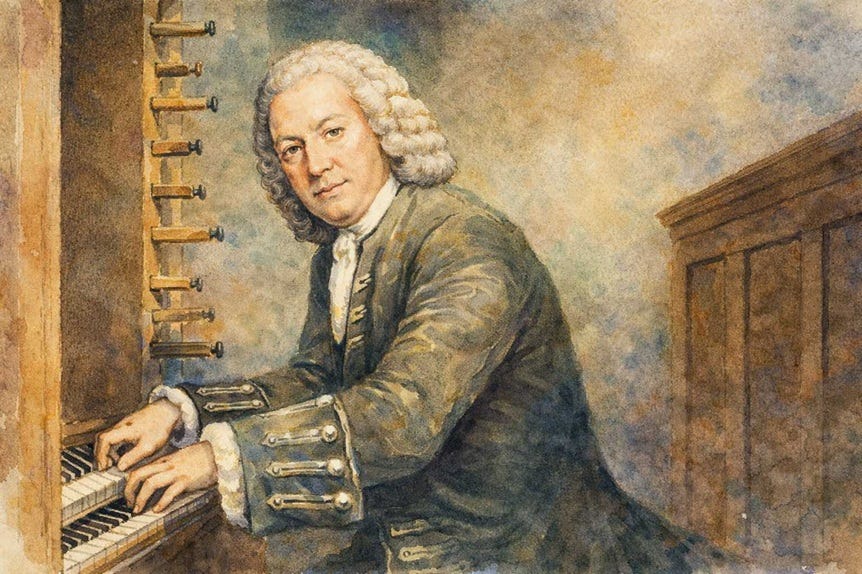
When facing difficult challenges in his work, Einstein would turn to music for relief and inspiration. He often began his day with a few measures of Bach before touching a pencil. Not the whole piece, just enough to “tune the machinery,” as he put it. He said that playing Bach was like tightening the strings of his own mind.
Einstein was a lifelong violinist and amateur musician. He often described music as a way of thinking and feeling that mirrored his scientific approach. He believed in unified, harmonious forms and saw beauty in symmetry, proportion, and balance, ideas that resonated deeply with Bach’s music Albert Schweitzer noted, “Bach opens a vista to the universe.”
In a letter to a friend, Einstein wrote, “Mozart is the heart. Bach is the spine.” He once told a student that Bach’s music was “too perfect to argue with.” When he played Bach on his violin, he didn’t sway or smile. He stood still, as if he was inside a cathedral.
During a difficult stretch of work on unified field theory, he played the same Bach partita every night for a week. A friend asked if it helped. Einstein said: “It does not give me the answer. It reminds me there is one.”
When young physicists visited him in Princeton, he sometimes asked what music they loved. If they said Bach, he nodded. If they said they didn’t understand Bach, he said, “You wil when your mind becomes quiet.”
He once stopped mid‑performance during a quartet rehearsal. The cellist had rushed a passage. Einstein simply said, “Bach is patient. We must be also.”
At a benefit for refugee children in the 1930s, He was asked to play something cheerful. He chose Bach instead. When someone questioned it, he said: “Children understand honesty better than cheerfulness.”
During a violent storm in Princeton, the power flickered. He lit a candle and played Bach slowly. A neighbor later said it looked like he was “holding the storm still with a bow.”
A young violinist once asked why Bach felt harder to play than Mozart. Einstein said, “Because Mozart forgives you. Bach expects you to grow up.”
Near the end of his life, his hands trembled too much for fast passages, so he gravitated to Bach’s slow movements. He said they were “closer to prayer than performance.” He played them until he couldn’t play at all.
Whether people know it or not, they hear Bach everywhere: in pop songs, film scores, heavy metal riffs, and even in the quiet logic of Einstein’s equations. Bach is the ghost in the machine. Einstein simply recognized the ghost and invited it in.
Story by Michael Jackson Smith - About me
I really love this series. My personal physicist is also an amateur musician.